Carrying On
I am a lifelong seeker of just the right word.
I’ve always been this way. I don’t know how or if it resulted in my becoming a writer, although there are obvious arguments to be made. I had my fingers in many pies when I was younger, though, and I never had a clear-cut calling. Nothing I was good at seemed to lead to a normal sort of life, and I was terrified of being different, unorthodox.
But it definitely turned out that this is how I prefer to communicate. You know that theory about dreams, that it’s our unconscious sorting through the day’s events, filing things in their proper places?
That’s what writing is to me. I don’t produce art; I’ve never understood having writing time or a writing place. I’d never say, I need to go somewhere and write. It would never cross my mind.
There’s been a missing word lately. There was something going on, something drawing me in a particular direction. This sounds woo-woo, I guess, but it’s second nature to me. Maybe it’s the forced introspection that came from getting sober 20 years ago.
I just tend to watch and wait, see what’s simmering, and eventually it clears up.
I’ve been dancing around several subjects for the past few years, and mostly I’ve just been stockpiling information. I’ve always enjoyed learning history, and even though I never expected to dig down into world history as much as I have, I didn’t have a lot on my plate at the time.
It also filled in gaps I thought I had. Take Hannibal. Before, if you said Hannibal, I said, “Elephants. Alps.” That’s it. I couldn’t place it in time. I didn’t know why he needed to take elephants up into the mountains. I didn’t know what elephants were doing in southern Europe. I didn’t know who was fighting whom, and I didn’t even know whether it was in the Current Era or Before. I knew nothing of Carthage but the name.
Same with Cleopatra, really. Alexander, Charlemagne. I certainly knew next to nothing of medieval England, other than what I gleaned from Shakespeare and The Lion in Winter.
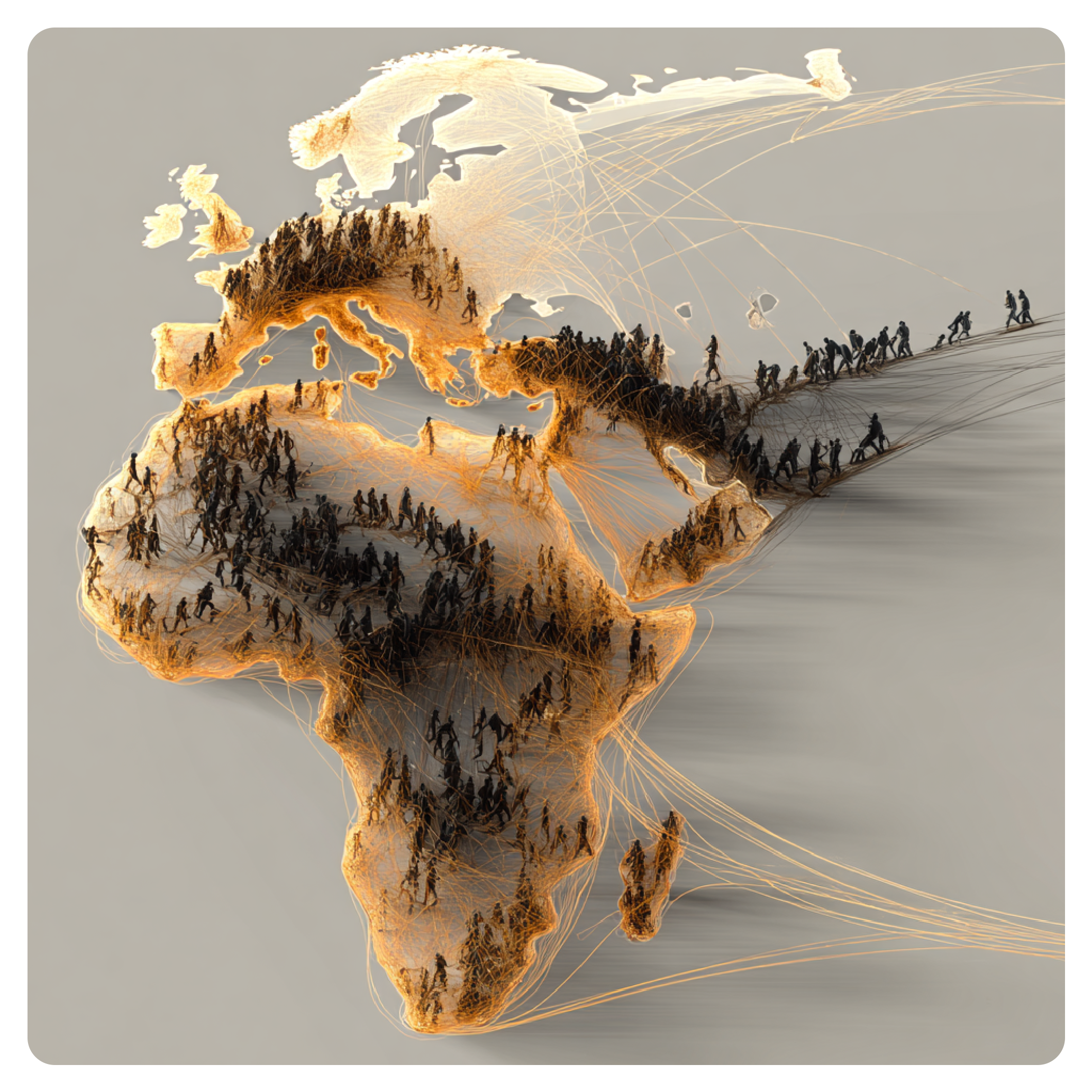
None of this is necessary, just comforting. But when I began looking further back, and realized that early/archaic humans were fascinating to me, as well as a long interest in human migration out of Africa, it seemed that there was a theme buried in there.
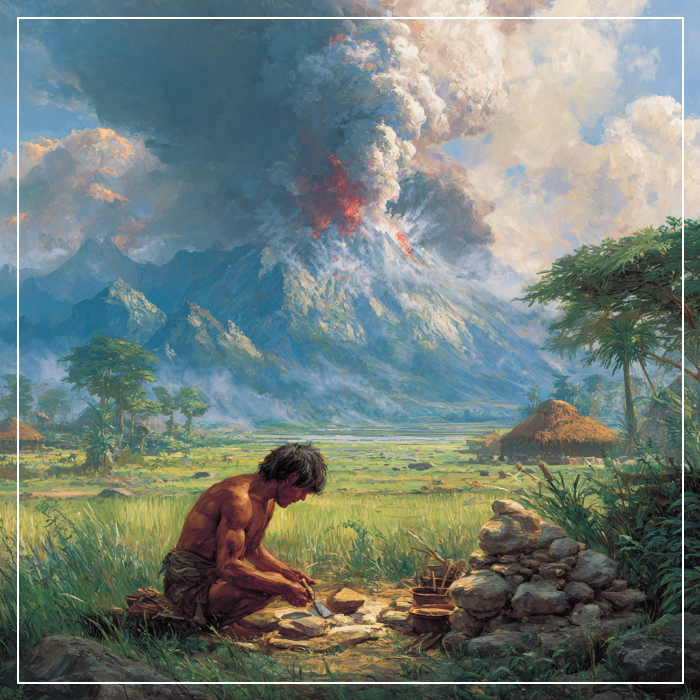
And then I started thinking about major geologic or climactic events, and it got very interesting. Around 75,000 years ago, the most powerful explosion in the past 25 million years occurred in Indonesia, on Sumatra, when the Toba volcano erupted.
There’s a theory that this eruption caused a permanent winter effect for many years, decimating the human population and being responsible for creating a bottleneck of perhaps only 1000 to 10,000 humans.
This has been mostly discredited by further investigation, particularly the finding that the same artifacts and cultural levels found underneath the ash were also found above it, suggesting no interruption or back-sliding. It also appears that the climatic changes were minimal.
Then there’s the 8.2ka (8200 years ago) event, when two giant lakes in Canada, the result of the melting ice sheets at the end of the last ice age, suddenly broke through something (probably an ice barrier), dumping all that freshwater into the Atlantic. Global temperatures cooled for as long as 4 centuries, and it became much drier.
Other things were going on, and the entire event is suspected to consist of several components, including a massive underwater landslide off the coast of Norway and a tsunami, resulting in the displacement of swaths of Mesolithic peoples and a permanent sea level rise. It was the final straw in the submersion of Doggerland, the marshy, forested land that connected Great Britain to the continent and now lies underneath the English channel.
And that wasn’t the only geologic event that changed human history. Four-thousand years later, a global drought rearranged everything, reducing the world’s first great empire, the Akkadians, into a footnote and creating chaos in Egypt that took centuries to resolve.
I think the word I’m looking for is resilience. I think at this point in my life, this is something that interests me. We’re probably here and the Neanderthals and Denisovans and probably many other kinds of human beings are not because we were better at surviving. We found more sources of food (Neanderthals were not fishermen). We were just good at it, apparently (obviously).
I don’t want to be theatrical. I’m just aware when something’s on my mind, and I seem to be circling this idea that we’ve evolved to overcome. And since I sort of need to do some overcoming, it makes sense to me. Your opinions (and interest) may vary. 😬